Alex · Student / OYAP
From school shop to skilled trade.
Discover OYAP, co-op and the nine steps toward a 310B qualification.
Loading website…
ELITE AUTO SKILLED TRADE COLLEGE / ONTARIO 310B
Choose where you are today. We’ll show you the pathway and a practical next step.
ONTARIO 310B
Explore collision repair through school co-op, then work toward registered apprenticeship.
Discover OYAP, co-op and the nine steps toward a 310B qualification.
English audio and captions · Fictional AI-animated story
Your eligibility, training credit and next steps must be confirmed for your situation.
Discover 310B in the school shop
Check the school requirements
Arrange a 310B co-op placement
Learn safely and try the work
Discuss sponsorship and registration
Explore eligible Level 1 classes
Finish school and continue training
Complete the apprenticeship
Work toward the 310B qualification
OYAP participation and registered apprenticeship are distinct steps.
Joining OYAP does not automatically register you as an apprentice. School credits do not automatically become apprenticeship credit.
Talk to your guidance counsellor, co-op teacher or school board’s OYAP recruiter about collision repair. They can help plan your next steps.
OYAP generally requires age 15 or older, at least 14 school credits, and Grade 11 or 12 or equivalent enrolment, part-time or full-time. Eligible students may start in the summer after Grade 10. Your school confirms eligibility and handles the participant form and required consent.
Work with your school to arrange a suitable collision-repair co-op placement. Complete school preparation and workplace safety orientation before practical learning begins.
Earn high school co-op credits while exploring the trade under supervision. Record your learning with school and workplace. Being an OYAP participant does not automatically make you a registered apprentice.
With a suitable sponsor and school support, apply to Skilled Trades Ontario. After review, your Training Agreement must be registered. This can happen while you are in high school; follow the applicable under-18 signature process.
Some registered OYAP apprentices may access Level 1 before graduation, depending on availability and eligibility. Your school and Skilled Trades Ontario can help confirm options and any recognized training credit.
Finish high school and continue with a suitable sponsor. Combine workplace skills and sign-offs with approved in-school Levels 1, 2 and 3. The typical full 310B apprenticeship is 7,280 workplace hours plus 720 in-school hours: 8,000 hours, approximately four years. Recognized prior training may count; this is not necessarily four additional years after graduation.
You and your sponsor submit completion records to Skilled Trades Ontario. Once requirements are confirmed, you receive a Certificate of Apprenticeship. The certifying examination still comes next.
Follow Skilled Trades Ontario’s exam instructions, including payment, authorization and any accommodation arrangements. Pass the examination and complete certificate issuance requirements to obtain your Ontario 310B Certificate of Qualification. Keep it valid. This is a Red Seal trade.
These are introductory explanations of provincial training levels, not approved Elite Auto lessons.
 01
Get to know the vehicle, the workplace and the reasons behind a repair.
A vehicle arrives with a damaged headlamp. You can see a crack, but the outside view does not tell the whole story. A learner asks the trainer what needs to be checked before work begins.
The trainer explains the task, the work area and the information needed. The learner begins by observing and asking questions. This is a way into the foundations of 310B: work practices, vehicle construction, tools and materials.
Assessment: Checking what is damaged and what information is still needed.
No. It gives you a starting point. A trained person needs to assess the damage and consult the information for that vehicle.
 02
See how different materials and vehicle systems change the work involved.
Two vehicles have damage near a bumper. One has a damaged plastic part; the other also needs glass and corrosion protection considered. The learner notices that a similar location does not make the jobs identical.
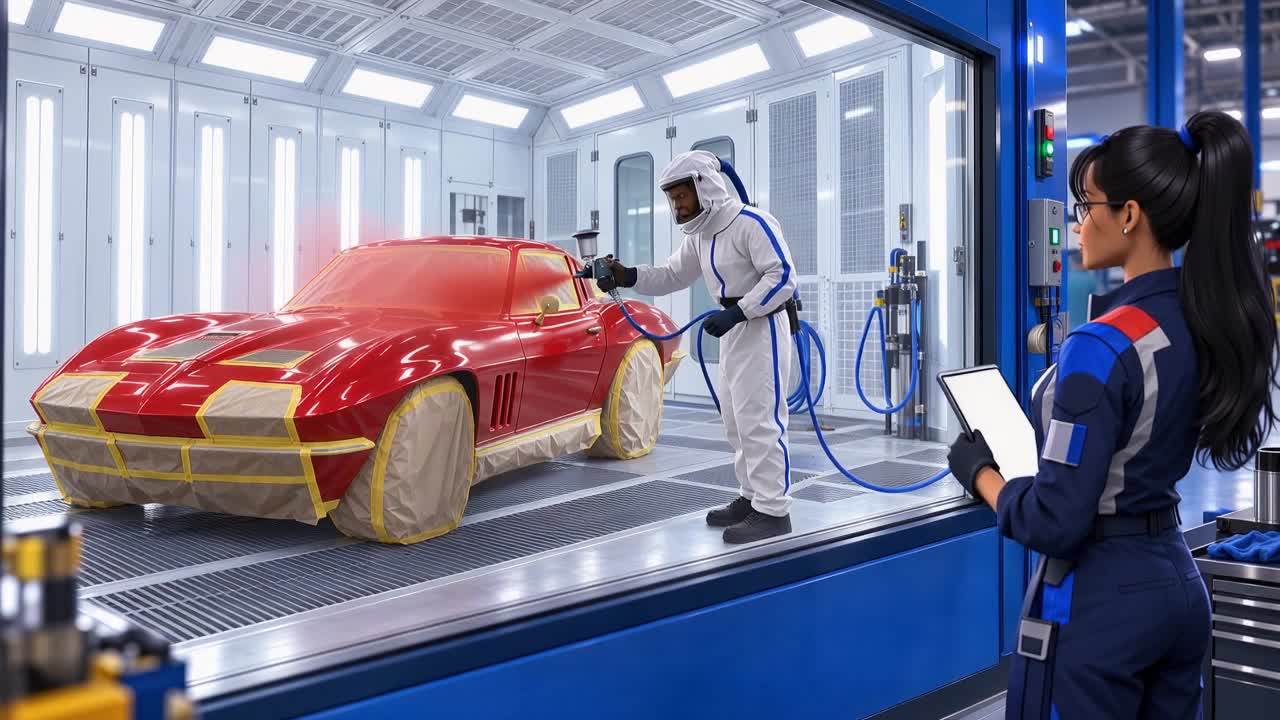
Knowing the material and the affected systems helps a trained repairer plan the work. Level 2 develops areas such as plastic repair, glass, corrosion protection and refinishing. A short video cannot show all the knowledge or practice involved.
Corrosion protection: Measures that help protect the vehicle’s metal from rust.
No. The materials, affected systems and vehicle-specific repair information need to be considered.
 03
Understand how damage analysis, structure, alignment and finish fit together.
A repaired vehicle looks good from across the shop. The learner asks, “Is that enough to know the work is complete?” The trainer points to the repair records and explains why appearance is only one part of the picture.
Level 3 brings together areas such as damage analysis, structural work, steering and alignment, colour matching and mechanical topics. The important idea is to connect the work and its checks, rather than judge the result only by how it looks.
Repair plan: A record of the work and checks identified for a particular vehicle.
No. Appearance alone does not establish that the required work and checks have been completed.